MCAT Prep Guide
3 min read
This article by Mommina Ashaque (CC '23) details preparing for the MCAT.
Nearly all medical schools in the United States require applicants to submit their score(s) on the MCAT (Medical College Admission Test) – a standardized examination that tests one’s understanding of the sciences (Biology, Chemistry, Organic Chemistry, Psychology, Sociology), critical thinking, and logical reasoning. Given the extent of material that the exam covers, it can be overwhelming at first and it is important to find the best studying approach for you. This article will address the different techniques one can employ to prepare for this exam – in a manner that will suit them best.
What does the MCAT cover? (Format/Topics)
The MCAT is a 7.5 hour exam and covers the following topics:
-
Biological and Biochemical Foundations of Living Systems
-
Chemical and Physical Foundations of Biological Systems
-
Psychological, Social, and Biological Foundations of Behavior
-
Critical Analysis and Reasoning Skills
Many students are exposed to these topics in high school and throughout their undergraduate careers (especially for Neuroscience/ Biology majors) so it is always helpful to revisit these topics from classes and review them. If you haven’t been exposed to some of these concepts or you need some extra practice you should consider purchasing an MCAT review book, which will offer a plethora of strategies, practice tests, content overviews, and additional resources. These are a great resource for the MCAT that can help fill in any missing gaps! The following books are some of the more popular ones:
-
Kaplan
-
Barron’s
-
Princeton Review
-
ExamCrackers
Each of these books have their advantages and disadvantages. What works best for you will entirely depend on the type of student you are and how you review material best (e.g. visual learning, cognitive learning, memorization).
In terms of format, this test is entirely multiple choice and should last 7.5 hours with breaks, and approximately 6 hours and 15 minutes excluding breaks. The subjects that are covered are not equally tested! For instance, biology remains one of the more heavily tested areas compared to other topics (i.e. organic chemistry, physics, and sociology). Due to this, you should plan your time when studying accordingly, concentrating on topics that are covered more. It should be noted that the attached diagram of the MCAT questions breakdown is in no way absolute- these percentages and the number of questions attributed to each topic change during each MCAT. It is more important to cover all of the material content, and simply place extra precaution for certain topics.
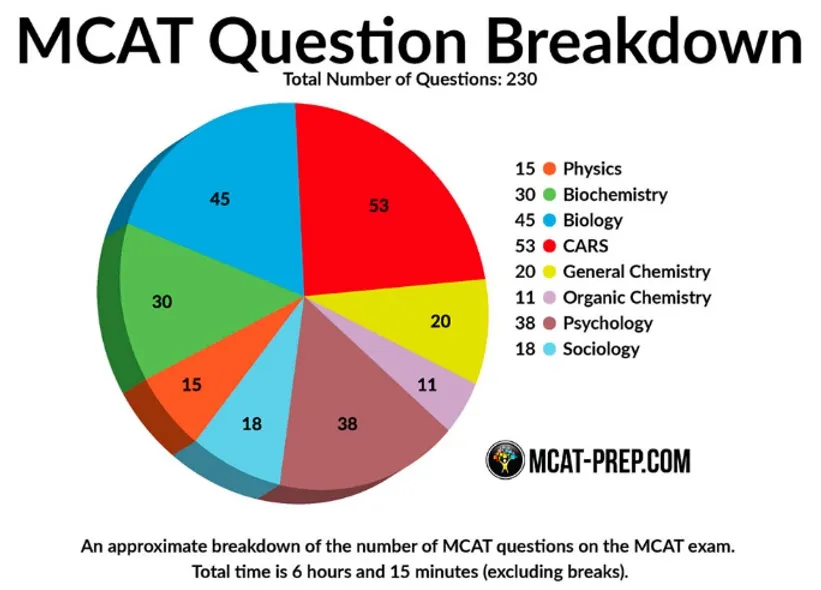
Preparing for the MCAT also means studying for CARS (Critical Analysis and Reasoning Skills), which will test your knowledge to maneuver passages and extract important information, and apply them in answering questions. This section will be more effective through practice alone, as you begin to adopt a feel for the style of questions asked and how to focus on key information and broader ideas.
Taking A Gap Year
Many students (if not the majority) take a gap year in order to provide themselves with sufficient time in studying for this exam. While this may not be the right choice for everyone, it is certainly something that one should consider if they feel they need more time to study. According to the Princeton Review, most people that take this test give themselves with 4-6 months total in studying for this exam.
Doing practice problems is important as well, and most of the aforementioned material/ MCAT books provide content review questions (with varying degrees of difficulty). If you find yourself unable to process this information, or need a more personal approach for effective studying, you can also consult a tutor to work on your weaker points.
Registering for the MCAT
This is an extremely critical component of the MCAT, because the seats for this exam fill up very quickly. You should certainly develop a plan of when you will be taking the test, and apply for it well in advance of the actual set date (consider a few months ahead of time). Otherwise, you might end up being forced to postpone your test date and even take a gap year if you are unable to apply in time. The MCAT has different dates, and each of them have their own deadlines for applying for that respective date (60 day deadline, 30 day deadline, and 10-29 day deadline). The costs for applying increase the closer you get to the actual test date (with 10-29 days before being the most expensive) and are another thing you should consider when applying.
With that being said, do not stress! A lot of people end up forgetting critical information due to paranoia and trepidation for the test, but taking practice exams in test-like conditions to prepare yourself for the real day will prepare you for this. Good luck preparing!
Sources
https://www.mcat-prep.com/what-is-the-mcat/
How to juggle MCAT prep and work. The Princeton Review. (n.d.). Retrieved March 24, 2022, from https://www.princetonreview.com/med-school-advice/how-to-juggle-mcat-prep-and-work#:~:text=So%2C%20where%20should%20you%20start,hours%20of%20MCAT%20study%20time.