Med School Application Timeline
2 min read
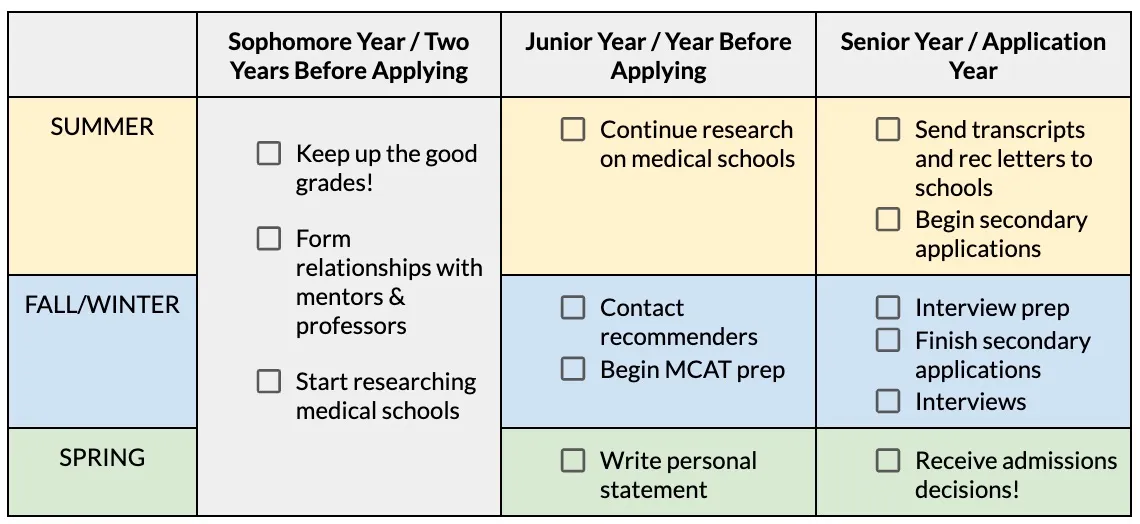
This timeline detailed by Caroline Hulber (BC '25) is a helpful guide for figuring out when to apply to medical school and how to prepare.
Applying to medical school is undoubtedly a long process, and it can often feel overwhelming without a concrete plan. This article is here to serve as a suggested timeline for the application process, though the plan may be adjusted should applicants choose to take a gap year after their undergraduate career.
Sophomore Year / Two Years Before Applying
The Princeton Review suggests that applicants start researching medical programs that interest them and continue establishing relationships with mentors who could later write strong letters of recommendation.
Junior Year / Year Before Applying
FALL/WINTER
Applicants should begin contacting potential recommenders, including one humanities teacher, one STEM teacher, and optional research or shadowing mentors. Applicants can provide recommenders with a brief profile or bio to help them write the best recommendation possible.
This is also an ideal time to begin thinking about the MCAT. This means taking a practice test, registering for the test, and making a study plan to achieve your ideal score. Juniors should plan to take the exam no later than mid-May to receive their scores by June. The links to the 2022 MCAT Test Dates can be found here: 2022 Test Dates. You can also view our guide to taking the MCAT here!
SPRING
Applicants should begin writing their personal statements and request applications from non-AMCAS medical schools. These schools do not use the American Medical College Application Service and have separate applications that must be requested directly from the schools. Applicants should begin filling out the primary AMCAS application when it opens in May. This is also when applicants should start ordering and collecting official transcripts from all colleges they have attended, along with letters of recommendation.
The Association of American Medical Colleges suggests using the Medical School Admission Requirements (MSAR®). This database allows applicants to browse information about US and Canadian medical schools to confirm school-specific requirements.
Senior Year / Application Year
SUMMER
By June of the summer before applying, applicants should have a finalized list of medical schools they are applying to. This is also when applicants should send official transcripts and letters of recommendation to AMCAS and non-AMCAS schools.
Starting as early as the July before senior year, medical schools will begin reaching out to applicants who they view as strong candidates for admission with their own secondary application. These applications help applicants demonstrate why they are interested in the institution they have applied to, including how their own goals and experiences align with the institution. It is also an opportunity for applicants to highlight how they see themselves contributing to the medical school as a student. It is important to note that submitting these applications sooner rather than later is beneficial, as applicant pools typically increase later in the year.
Interviews:
Most medical schools require interviews, which are evaluated and used as supplementary application materials. Early senior year is an ideal time to start preparing for interviews.
FALL/WINTER
During the fall, applicants should continue finishing and submitting secondary applications and completing interviews. Applicants will begin receiving admissions decisions in the late fall through spring of their senior year!
Upon receiving acceptances (and rejections), applicants will decide what school they plan to attend the following fall and inform AMCAS and their medical school of their decision by May 15th.
Take the summer to relax and go through orientation before beginning life as a medical student!