4-Year Pre-Med Timeline at Columbia
Updated: Apr 23, 2022 · 6 min read
Wondering about the schedule of other pre-med students? Read this article by Akshay Pokala (CC'25) and Brendon Choy (CC '22) for some guidance.
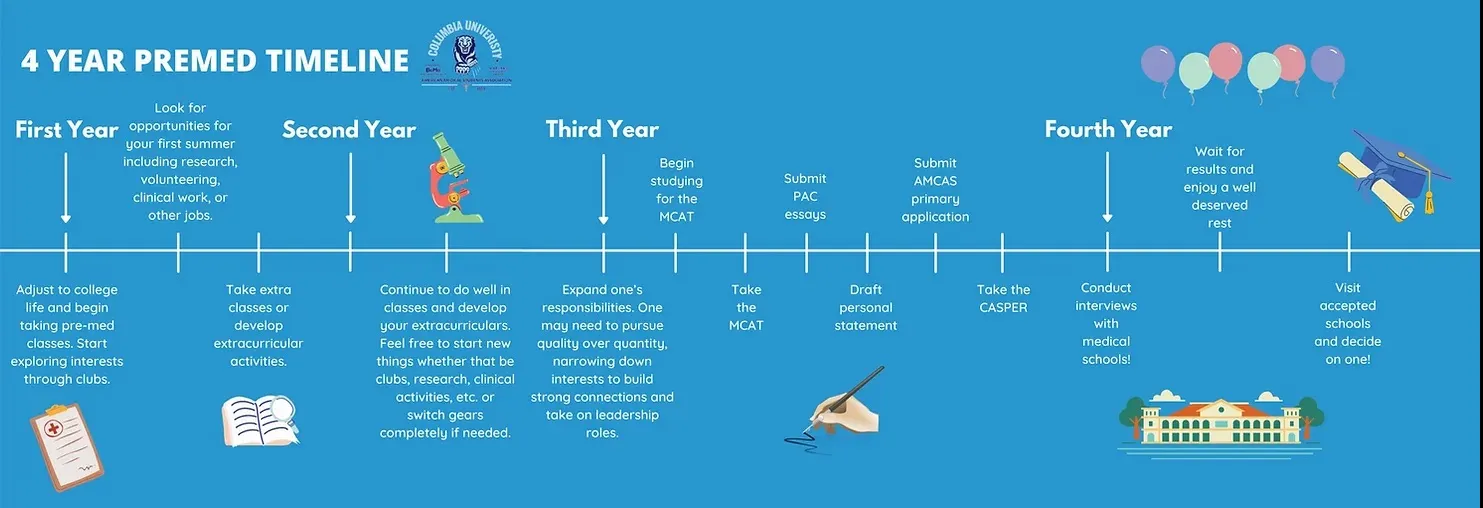
When is the MCAT, and when should I start preparing for it? Should I start research as early as my freshman year? What are the pre-med requisites? Do not fret — these are all common questions pre-med students have during college. To help you, we have outlined below a 4-year sample timeline which highlights what to focus on year-to-year, if you do not intend on taking a gap year(s) before medical school. If you do plan on taking one, adjust the timeline accordingly, specifically for your MCAT studying and application preparation.
First Year Students
Classes:
Potential pre-med classes could include 2 semesters of general chemistry with lab and a statistics or calculus course.
Clubs:
During your first year, it is important to adjust to college life. While you can start taking pre-medical classes like chemistry, getting involved in research immediately or in an internship is not a necessity. Instead, you can join clubs related to your interests and develop new passions by trying new organizations. Some examples of clubs are intramural sports, dance groups, literary magazines, medical associations within your university, and specific subject-related clubs (like a chemistry, neuroscience, or biology club).
Internships:
Additionally, during your first year, you may want to look into and set up opportunities for the following summer before sophomore year. Many schools offer information sessions regarding how to secure research opportunities, clinical experiences, or volunteering hours. If research appeals to you, finding a lab is encouraged, so that medical schools can see your contributions in medicine and/or science early-on. Our guide to finding research opportunities can be found here: Finding Research Opportunities at Columbia.
The summer following your first year can also be spent by completing coursework to free up your semesters later-on and even take more advanced science classes you are interested in.
Second Year Students
Classes:
During your second year at Columbia, two semesters of biology with lab and two semesters of physics (or organic chemistry) with lab is a standard next step after general chemistry. Starting major requirements earlier is also a good way to free up time in your schedule later-on. SEAS students are expected to declare their major during the first semester of their sophomore year, and Columbia College students will declare theirs mid-March of sophomore year.
Clubs:
As a sophomore, you should start narrowing down the clubs you are involved in to ones you are most passionate about. This is also a great time to gain leadership experience within your clubs by being more hands-on and joining their boards.
Internships and Research:
Continuing internships from the previous summer, whether it is volunteering at a hospital, in an organization, or researching in a lab, is a great way to establish long-term commitment to certain activities and build strong relationships with mentors who can write your letters of recommendation later on. But, do not worry if you shift gears during this second summer at college! It is perfectly okay to, for example, find a new lab or stop researching entirely if it does not suit your interests. Exposing yourself to clinical environments and experiencing direct contact with patients are great ways to show your commitment to a career in medicine.
Third Year Students
Classes:
Many juniors opt to take two semesters of organic chemistry (or physics) with lab as well as psychology and biochemistry (in separate semesters). By doing so, the content on the MCAT will have been covered in classes by May, although, you do not need to have taken all the relevant classes before taking the MCAT and often some students will have to self-study one or two. Other major requirements can also be completed this year.
Internships and Research:
During the school year and into the summer, students will often continue to build on their various activities and experiences, in clubs, in volunteering, or at lab. You may also begin the various parts of your application described below and research the schools you are applying to in order to double check all prerequisites have been met.
MCAT:
The third year is generally the most intense year in terms of rigor and course load. Taking classes related to your major as well as completing other medical school requirements will be a challenging balance. Students who do not intend on taking a gap year will choose to take the Medical College Admission Test (MCAT) sometime during their junior year often right after winter break. So, finding time to study for this exam while staying on top of coursework is crucial. Since the MCAT is offered eight times per year, you have opportunities to retake it, if necessary. You should aim, however, to take the MCAT by May at latest, so that you can receive your scores by June and include them in your application.
PAC:
Columbia students are required to submit an application to the Premed Advisory Committee (PAC), an internal group at Columbia, the year before they plan on matriculating in order to apply to medical schools. This would be done junior year for those not taking a gap year. This application requires all the letter of recommendations that the student will send to medical schools, descriptions of activities, and responses to several essay questions. The PAC committee compiles your letters and writes a letter of their own, and this application is usually due in February. Thus the core of your experiences should already present by this time. There are, of course, ample opportunities to update the PAC committee with new experiences which occur after this application is submitted. If you are not a Columbia student, please refer to your school's specific pre-health advisory groups or committees for instructions.
AMCAS Application:
Often students will begin working on their AMCAS primary medical school application in May which includes descriptions of their activities and a personal statement. The earliest time students can submit this application is usually around the end of May and students try to submit their application as soon as possible (ideally within the first two weeks of June) since AMCAS can take around 3-6 weeks to verify your application before transmitting it to medical schools.
For those who submitted their primary as early as possible, school-specific secondary applications with school-specific essays usually begin rolling in from the end of June through July. The later you submit your primaries, the later these secondary-applications will come. Because of the volume of essays received, students often opt to pre-write answers to common secondary essay prompts while waiting to receive them. Most of the summer is filled with writing these secondaries and the ideal turnaround time is to return the essays is as soon as possible within two to three weeks of receiving the prompts. However, there is no rigid deadlines on this, and medical schools understand that you're likely getting many secondaries, so returning some at four weeks is fine. The main idea is to just not procrastinate on them.
CASPER:
This online open-response situational judgment test is required by some medical schools. Often students will take this test sometime mid June, or earlier. You are not supposed to "prepare" for the test, but students will often do some type of practice or at least familiarize themselves with the test a few weeks before they take it.
Fourth Year Students
Classes:
The fourth year can be spent finishing any major requirements that have not been completed yet, as well as any university requirements, such as the Columbia Core. Students may also take electives or less intensive classes if they have finished their requirements.
Application Process Continued:
You may have additional secondary applications to finish up writing, but often people are done with these sometime in August. After that, the next (and final) step in the medical admission process is interviews. Most of senior fall will be spent waiting on interview requests. It is best to leave a lighter schedule if possible to accommodate for full day interviews, and preparing for these is crucial, so you can present yourself well and put your best foot forward for these schools.
The Finale:
Most interviews are finished by second semester at which point you tend to wait for decisions to come out between January to March. Congrats on making it through this long process. Step back and relax. It can be an anxious and exciting time, so take care of yourself and of course, reenergize before the medical school journey starts!
If you plan on taking a gap year before medical school:
If you choose not to take a gap year, you will still be able to get into medical school directly after being an undergraduate a year earlier. However, more than 80% of Columbia’s pre-med students end up taking at least 1 gap year. Taking a gap year after your four years of being an undergraduate can be very insightful -- you can develop research skills, gain volunteering/clinical experience, and also spend time preparing for the MCAT before and during senior year. If you are only taking one gap year, you can then begin applying for medical school during the summer after senior year and use the gap year to complete secondary applications and interviews, as well as continue to research and volunteering. A guide on deciding if you should or should not take a gap year can be found here: Gap Year vs. No Gap Year.
Sources
https://www.princetonreview.com/med-school-advice/admissions-timeline
https://crackingmedadmissions.com/medical-school-application-timeline-2021/